It’s Monday morning at a managing agent’s office, and there are forty new emails across a dozen schemes. Nine subject lines say URGENT. One is a burst main valve flooding a basement. One is a complaint that a neighbour’s washing is visible from the street. The other seven are somewhere in between.
They all look the same in the inbox. So they get handled in the order they arrived, or in order of how loud the sender is, and neither of those orders has anything to do with what matters.
What a flat list costs you
When every issue and job sits in one undifferentiated list, three things go wrong at once.
Urgent things wait behind noise. The flooded basement is item 23, and it gets found after the washing-line complaint has already had a reply.
Minor things feel ignored. Low-priority items really do wait. But without any visible reason, residents read the wait as neglect and escalate.
Loudness becomes the priority system. Residents learn that the fastest way to get something fixed is to email the agent, the chairperson and the owners’ group at once. The next complaint is a bit louder than the last one.
A body corporate has a duty to maintain the common property and keep it in good repair. That doesn’t mean everything is urgent. It means the scheme should be able to show that the things that were urgent were dealt with first.
A severity scale that works
You don’t need a detailed framework. Four levels are enough for almost every scheme, as long as everyone uses the same definitions.
| Level | Means | Examples | Aim to act |
|---|---|---|---|
| Critical | Safety, security or active damage | Burst pipe, gate stuck open at night, exposed wiring, sewage leak | Same day |
| High | Getting worse, or affects many people | Roof leak into a unit, intermittent gate motor, lift out of order | Within days |
| Medium | A real problem that isn’t spreading | Repeated noise complaints, cracked paving, faulty common-area lights | Within weeks |
| Low | Cosmetic, or can wait for scheduled work | Faded signage, paint touch-ups, garden edging | Next planned cycle |
Change the names, colours and response times to suit your scheme. What matters is that the scale is written down and used the same way by everyone.
Four rules that keep it honest
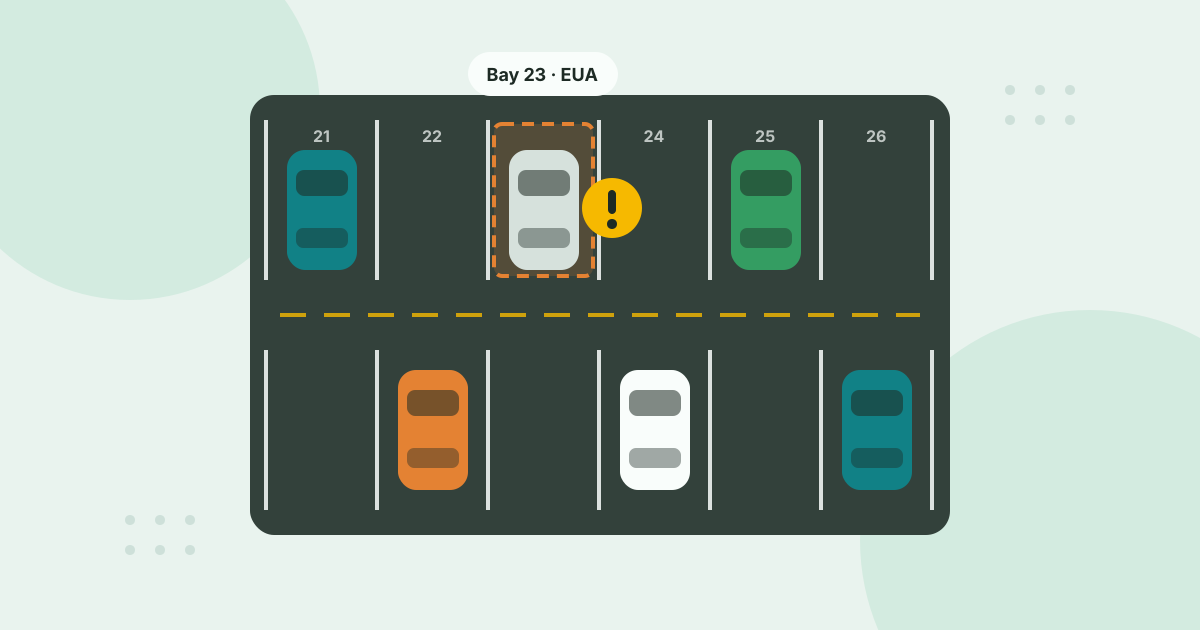
1. Severity describes the impact, not the person who reported it. A trustee’s complaint about their own parking bay is no more severe than a tenant’s.
2. The person who triages sets the severity, not the person who reports. Residents will mark everything critical, and that’s understandable. Let them describe the problem. Someone who can see every other open item decides where it goes.
3. Reassess it. A medium-severity damp patch that has spread across a ceiling is now high. Severity reflects the situation today, not what it was when the report came in.
4. Make it visible. When a resident can see that their item is logged as medium and why, “why hasn’t anything happened?” usually becomes “OK, I see.” Visibility doesn’t make the queue shorter, but it prevents a lot of escalation.
Complaints and maintenance are different queues
A conduct complaint is resolved by notifying an owner and enforcing a rule. A maintenance problem is resolved by sending someone to fix it. They need different workflows, but both need a severity, and one often leads to the other.
The neighbour’s leaking geyser starts as a complaint and becomes a job. The scheme’s records should show both, linked, so the complaint isn’t closed while the ceiling is still wet.
Where to start
- Agree on the four levels at the next trustee meeting and minute them, so the scale is a decision and not one person’s preference.
- Triage the backlog you already have. Most schemes find that only one or two open items are really critical, and that at least one of those has been waiting too long.
- Send the severity with every issue you pass to the managing agent, so their inbox gets sorted by what matters.
Once the whole list isn’t marked urgent, it’s much easier to see which items actually are.